A financial freedom date is only as useful as the numbers behind it. Start with what the app includes, what is missing and which assumptions you chose.
The latest WealthIQ work in the TradeLab app adds connected and manually reported account coverage, passive-income coverage, planning scenarios and purchase comparisons. These are planning tools, not financial advice. They do not predict investment returns or guarantee financial freedom.
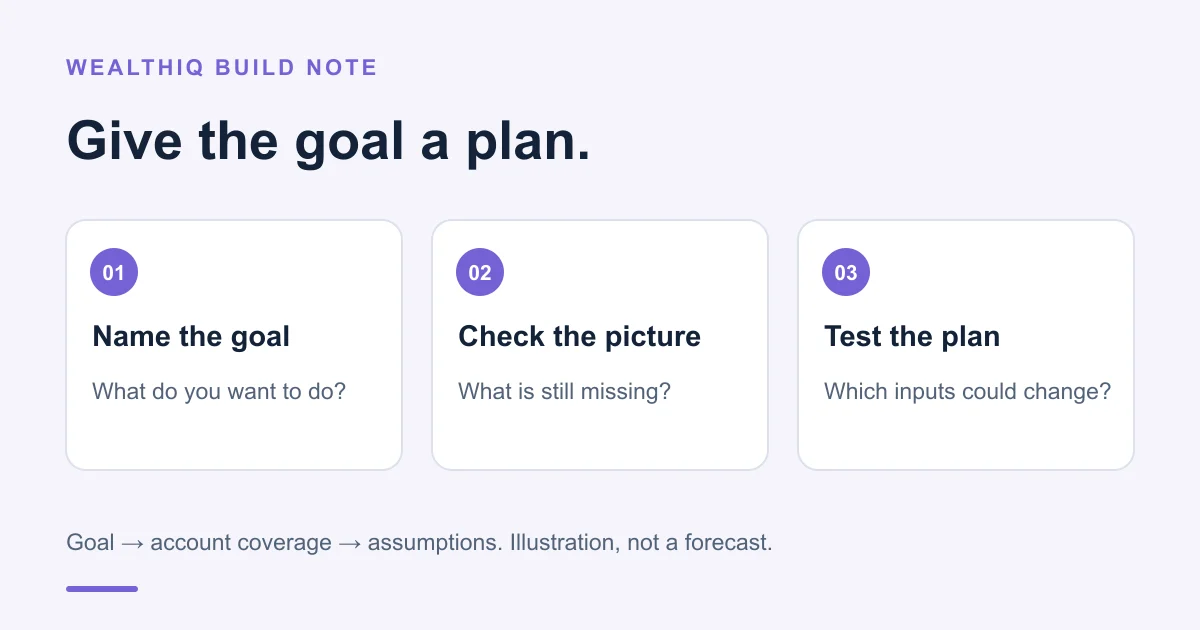
Check which accounts are included
Supported linked accounts can provide part of your financial picture. Manually reported accounts let you add information that is not connected. Review their dates and avoid counting the same account twice.
An account you have not added is unknown, not zero. The current release does not mean every bank, retirement plan, property or debt is synced. Manual entries still need to be kept current.
FINRA’s financial foundations guide defines net worth as what you own minus what you owe. A partial list of either side gives a partial picture. Check account coverage before reading a headline total.
Separate net worth from money available now
A retirement balance, a property value and cash in a bank account are different kinds of resources. They should not all become money you can spend today.
The planning work separates account types and access to funds. That helps expose an important question: does the plan depend on money that is not available for the goal you have in mind?
Read passive income beside recurring expenses
The app’s current coverage measure compares reported monthly passive income with recurring living expenses. It is a view of those inputs, not proof that income will continue or that all costs have been captured.
Check the income amount, its source and the expenses used. Include the costs that belong in your own plan. A percentage cannot repair a missing bill or a stale manual entry.
Change the assumptions before trusting the timeline
Planning scenarios let you compare different assumptions. A higher assumed return can make a date look closer. It does not make that return more likely.
The Investor.gov compound interest calculator also separates starting money, monthly additions, time and an estimated rate. It includes a rate range so you can compare assumptions. A calculator’s inputs are not market promises.
Check contributions, expenses, inflation, account access and the time period beside any result. The app’s scenarios are illustrations, not a personal recommendation to buy, sell or borrow.
Compare the ongoing cost of a goal
The latest purchase comparisons look beyond the first payment. The buy-side planning work includes recurring ownership costs and loan payments while the loan remains outstanding.
That gives you a better question to ask about a dream purchase or trip: what changes in the monthly plan after the first day? The examples do not decide whether a car, a vacation or an investment is right for you.
A five-minute planning review
- Name one goal and the date you have in mind.
- List included accounts and anything still missing.
- Check recurring costs and reported income.
- Compare at least two sets of assumptions.
- Write down what would make you change the plan.
November 8 update: where WealthIQ fits in the larger IQ direction
Tim has clarified the goal: one IQ app with access to BusinessIQ for business work and WealthIQ for personal wealth. This is a product direction, not an announcement that the applications have been joined.
For the planning view, the useful question stays personal: what are you trying to make room for? A goal, a budget and a realistic view of available money need to stay connected. Trading research is one part of that picture.
A shared app should not blur who owns a record or who is allowed to see it. Business information and personal financial information need their own boundaries. That is a requirement for the intended design, not a claim that new sharing or combined-account controls are live.
What a joined view should make clear
- Whose plan and accounts am I looking at?
- Which balances are current, delayed or manually entered?
- What information is still missing?
- Which number is a real balance, and which is a test or planning assumption?
- What action needs my separate approval?
Read Tim’s updated note on the life behind WealthIQ for the founder’s reason for this direction. This update adds context; it does not enable a transfer, payment or trade.
What comes next in the WealthIQ work
A revised goal board and private photo uploads have been implemented and checked in development. Their publication is pending. Do not expect those newer controls in the live app yet.
The current release does not enable new trading automation or move money. Trading research remains a separate activity. Our backtesting and paper-trading guide explains why a test and an operating process need separate checks.
See what the app supports today or the early-access waitlist. Use the planning view to make the questions clearer. Keep the assumptions visible when you use the answers.